"I hope life isn't a big joke, because I don't get it." - Jack Handey
Apparently the universe observes April Fool's Day, because it seems to be toying with me today.
Just three weeks ago I was celebrating my release from the stifling corporate environment, eager to start a new phase in my life with a move overseas and starting our own business just four short months from now. But to my surprise, earlier this week I got called up by a hiring manager asking me to interview for a position I technically didn't even apply for (mostly for the sake of due diligence with the unemployment office, I applied for a couple short term contract positions and several pie-in-the-sky positions within a specific company that I never thought I would be considered for). I didn't really think much would come of it, and so I said yes to an interview and picked Wednesday April 1st for the interview.... well, because at the time the thought of doing a job interview on April Fool's Day amused me a bit.
Well I had my interview today, and it went well. Surprisingly well. Even though I admitted I hadn't touched a Unix system in several years and flubbed a few of the Unix knowledge questions, and even though I told them straight-out that I have a lot of foreign relatives and have done a LOT of international travel (which can cause headaches/delays when getting approval for certain high-security government contracting jobs), I still got the impression they were wanting to hire me. Personally I don't think my credentials and experience are THAT impressive, and while I'm bright and learn and pick up skills & knowledge quickly, that's typically something that takes a little time to notice and isn't the sort of thing that easily comes across on a resume or one interview. I'm not sure if this is a measure of how good I am and how that is perceived by others, or simply a measure of how well I compare against a mediocre selection of candidates they may have seen before, or a measure of their desperation, or some combination of the above. It's not a dream position by any means but it's better than many out there, and in today's job market I would have thought there would be more competition for such a job. Then again, perhaps it's just a function of a phenomenon often seen in the dating world.... sometimes you're seen as more attractive when you're not actively searching and have a mildly laid-back attitude that shows you're fine with taking or leaving a given opportunity. And if there's one thing I have right now, it's certainly a "I don't give a f***" attitude about getting a job where I work for someone else.
Anyway, it's not a sure thing as of yet, as there's always the possibility that their security office might feel it will take too long to get the necessary approvals given my frequent foreign travels and foreign-born in-laws. But if they offer me a job and at a pay rate similar or higher than my last job, that puts me in a dilemna. Do I put up with one or two more years of a corporate environment I'm already way burned out on for the sake of further building our savings and investment capital by a very significant amount, yet push back or delay our plans to start up business for ourselves? Or do I say no to the job and charge forward with our original timeline, knowing we have enough money to get things started and to live off of for a few years but not much extra 'buffer savings' beyond that? Which is more valuable in our case, the time or the money?
No one said breaking away from the herd is easy, and just sometimes I admit it can be necessary to do as the herd does for a short time for the sake of a greater advantage. Sometimes it's necessary to take one step back in order to take two steps forward. I'm still trying to determine which is the more logical course for us, and at this point I'm about 50/50. The prospect of continuing the corporate drone route for another year galls me, yet we all have a responsibility to mitigate risks, financial or otherwise, at least to ourselves if not to our families (those of us who have families anyhow). Anyway, I guess I'll wait and see what the next week or two brings. And in the meantime, I'll raise my glass of beer in salute to the universe and toast its curious sense of humor...
Wednesday, April 1, 2015

Tuesday, March 17, 2015
Link of the Week: Job Security Most of Us Can Only Dream Of...
I think it's safe to say that job security in the US is a rather rare commodity these days. Heck, my own layoff over a week ago only underscores this point. BUT... if you are a government employee or official (elected or otherwise), not only are results and performance largely irrelevant to your job security, but you can get away with crap that even Dilbert's corrupt and clueless pointy-haired boss would look at and say, "oh, now that's just not right".
Red tape keeps some bad gov't workers from being fired
"In the private sector, if you're caught viewing porn on company time or intimidating a co-worker, you'd probably be fired immediately; not so if you're a federal employee.
A CBS News investigation looks at how hard it is for the U.S. government to discipline or fire employees who behave badly. With examples ranging from extravagant to explicit, civil service rules meant to protect public workers from political pressure may be backfiring, and costing you big, reports CBS News correspondent Don Dahler.
At the Environmental Protection Agency (EPA), red tape is preventing the removal of a top level employee accused of viewing porn two to six hours a day while at work, since 2010. Even though investigators found 7,000 pornographic files on his computer and even caught him watching porn, he remains on the payroll.
At a Congressional hearing, EPA administrator Gina McCarthy was asked why she hadn't fired the employee and said, "I actually have to work through the administrative process, as you know."
The administrative process meant to prevent against politically motivated firings is the civil servant protection system. The rules give employees the right to appeal a termination, a process that can take up two years.
"There is a big difference between trying to protect against that and what we have today," Partnership for Public Service president and CEO Max Stier said.
He said those rules make it nearly impossible to fire poor performers or problematic employees, even when they've committed egregious violations.
"Many managers would like to get rid of problem employees and find that they have to go through a challenging process," Stier said.
A CBS News analysis of cases under review by the Merit System Protection Board (MSPB), an appeals board for federal workers, found other instances of employees who had committed seemingly fireable offenses who were later reinstated to their jobs, often with back pay and interest."
You can read the rest at the original CBS link here.
Saturday, March 7, 2015
I'm Free....
"I'M FREE....... I'm free,
And freedom tastes of reality..." - Tommy, The Who
Yesterday was my last day at work, and I couldn't be happier. On the way home I happened to be listening to The Who's rock opera 'Tommy'. It really struck me how appropriate the song referenced above, "I'm Free", was to the way I felt, or at least the first part of it anyway. For the past 22 months it honestly did feel like I was in an artificial reality of sorts at this job, one where the things that went on and the decisions made would be comical and downright stupid in the real world.
See, my job was working at a co-located NOC / SOC (that's Network Operations Center and Security Operations Center for you non-IT folks) and Service Desk call center under a government contract. Specifically, it was for the US Citizenship and Immigration Service, a government agency within the infamous Department of Homeland Security (which USCIS doesn't really belong under IMO, and the fact that it was lumped within DHS speaks volumes about the paranoid and controlling mindset that currently reigns supreme within those running the US government). And while I do firmly keep to my commitment to not divulge sensitive information or specifics that might truly compromise national security (not that I was privy to much of any interest anyway), I think it's safe enough to simply give my opinion of how the organization is run. Quite simply, the way that the federal government, and especially DHS, operates is a frigging joke. The stuff I've seen that passes for normal there would drive any private business into the ground within a few years or less, and many of the decisions and actions made in the organization only make sense in the artificial reality that typically exists in over-sized government. The really sad thing is I suspect that comparatively speaking, USCIS was probably better run than most other government agencies, whether inside or outside DHS. So I feel at least a little like the deaf, dumb, and blind boy in 'Tommy' who is suddenly able to see, hear, and speak.... he having escaped from a reality defined by lack of sight and hearing, whereas I am leaving a reality defined by big government and bureaucratic idiocy.
Obviously, the former has a much larger impact on the individual than the latter. Still, time spent working in government definitely appears to change people, and generally not for the better. From most of the examples I've seen in this and previous government contractor jobs, the longer one works in government the more rigid and lazy one gets in their thinking. They don't necessarily become dumb (though a hell of a lot of dumb people sure find a place in government employment), but they tend to lose their ability and/or willingness to adapt to changes, think outside of the box, and see the bigger picture. It's a rare person who works a long while in government and still manages to stay sharp and adaptable. So it appears that it boils down to indoctrination and learned ignorance. Even worse, over time it tends to make said people less able to work and make a living outside of the government! I've seen this especially insidious trend play itself out with many coworkers (some of whom were contractors and not directly employed by the federal government), where their skill sets and experience (or in some cases, lack thereof) has railroaded them into careers in government or government contracting. I've even noticed this for myself, where a substantial portion of my work experience doesn't translate well to positions in the private sector.
For example, 11 months ago part of the contract we were working was awarded to a different company, so many of our job responsibilities were moved along with it. So for the past 11 months we had a handful of network administrators, some with very substantial experience & knowledge, essentially doing Sigourney Weaver's character's job in Galaxy Quest, serving as redundant go-betweens and repeating information other parties pass to us. Try describing THAT job on your resume or to a potential employer in an interview ;-)
(see Sigourney Weaver's 'job' in this clip from about 1:45 to 2:48 to get an idea what the last 11 months of my job was like...)
On my shift, not a lot usually happened. So essentially I was paid more than $75k/year to sit on my ass and watch 'Archer' on my tablet for the majority of my shift. Only in government and in companies that contract heavily with the government would such a job exist at that pay and use degree-holding IT professionals to do it.
So like I said in a prior post about this job ending, being laid off from it is hardly the worst thing that can happen to me. On one hand it would have been kind of nice if it lasted a few more months until this summer when we pull the trigger on our big move towards entrepreneurship (details on that I'll go into at a later date) as it would have allowed us to save a little more cash before that time. But on the other hand, it was getting harder and harder to put up with the idiotic bureaucracy and to keep doing a job that was so trivial and pointless. As easy as the job was, it felt like the pointlessness of it all and the bureaucratic environment was slowly poisoning me, making it harder to look forward to the next day and harder to focus on our business plans. So all in all I think the boost to my mental health and having the extra time to shift my mental gears 100% towards our future business makes up for the several thousand additional dollars we would have saved had I worked there a few more months.
So for all those out there tempted by a lucrative government or government contracting job, think really carefully beforehand about what you might lose in return. Even when one knows going in that a lot of it is BS and isn't applicable to the real world, it still takes its toll...
Friday, February 6, 2015
Link of the Week: China Needs Women
This week's link comes from Zerohedge, and is an amusing article on how people of two dysfunctional nations can come together (as Sterling Archer might say in response, "phrasing!") to find ways around their problems ;-)
BTW I have been to China several times, and the male-female disparity was noticeable at times. Not so much that one observed so many more men than women, but rather just seeing a high number of young, supposedly single men milling around in the evening. Anyway, here is your link:
How Ukraine Can Save China From Its Existential Threat (Spoiler Alert: Girls)
"In China last year, just over 115 boys were born for every 100 girls, and since sonogram technology was introduced to China in the 1980s - allowing families to determine a baby’s gender during the first few months of pregnancy - the gender imbalance in the world's largest economy has grown colossal. However, as Beijing News recently explained, there may be a solution for China's 34 million woman shortfall... Ukrainian women, as "their economy is depressed but beautiful women are running rampant." While Foreign Policy notes that the best destinations for Chinese men to find spouses are Japan and South Korea, there appears to be plenty of fish in the sea, at least outside China. Oh the wonders of Ricardian comparative advantage - Ukraine needs an export business (and produces - from what we have heard - attractive women) and China needs to import 'women' (to fill its massive shortfall). Global economic growth problems, solved..."
Read the rest at the link here, or copy/paste the link below.
http://www.zerohedge.com/news/2015-01-31/how-ukraine-can-save-china-its-existential-threat-spoiler-alert-girls
Sunday, February 1, 2015
My Job is Going Away, and I Am Thrilled About It
“I live in the Managerial Age, in a world of "Admin." The greatest evil is not now done in those sordid "dens of crime" that Dickens loved to paint. It is not done even in concentration camps and labour camps. In those we see its final result. But it is conceived and ordered (moved, seconded, carried, and minuted) in clean, carpeted, warmed and well-lighted offices, by quiet men with white collars and cut fingernails and smooth-shaven cheeks who do not need to raise their voices. Hence, naturally enough, my symbol for Hell is something like the bureaucracy of a police state or the office of a thoroughly nasty business concern."
- C.S. Lewis, [From the Preface] The Screwtape Letters
So it was approximately two weeks ago that my coworkers and I got our first ‘official’ announcement of when our contract, and hence our employment, is ending. As of today, we’ve got just under six weeks of employment left here. We all knew it was an eventuality once the contract was awarded to a different company last year, yet the mood in the office still seems somewhat somber with a tinge of desperation. The funny thing is that unlike most people here, I am actually looking forward to my employment and time here coming to an end. I am counting the days with anticipation, not dread.
Before you say it, no, I’m not mental. And no, I’m not planning to be a welfare sponge either. This is simply me being eager to move on to new things, and knowing that I don’t have to scramble to find any job available to pay the bills because we have put a lot of effort in increasing our financial resilience and living well below our means. This job was nothing more than a means to an end (that end being saving money for future business endeavors), and I am eager to leave this behind me.
Now before I start talking too much trash, let me explain that the company I work for is actually not a terrible place to work by any means. It treats us slightly better than what you typically might expect from any big corporation, and the (local) management is not only competent but they’re fairly considerate and forthcoming to the employees. It sucks working for them in the sense that it sucks working in just about ANY corporate environment, but compared to most corporations they are pretty decent.
No, the biggest issue I have with my job is that we work for a government customer, and just about every cliché regarding government incompetence, inefficiency, and cronyism has been demonstrated for us in spades. I’ve worked for poorly run private businesses before, yet both of those places end up looking like Apple or Google when compared to this particular government organization. It gets to the point where it can be funny to watch it unfold, at least until one remembers that it’s our tax dollars being used to fund this circus of ass-clowns. But while the incompetence and inefficiency displayed by the government organization and officials in question is grating, what I find hardest about working here is the work culture. The culture in this, and I expect most other, government organizations can be summed up as follows:
- Groupthink dominates everything.... sucking up and doing ONLY what you're told tends to gets you ahead, whereas independent thought and proactive behaviors more often than not just opens oneself to criticism from management and stalls ones career.
- Seniority and the approval of those with it trump the strength of any particular idea, plan, or proposal.
- Accepting responsibility and taking accountability for your actions is usually seen as only a risk to one's career, where avoiding accountability or spreading it around so wide it cannot be applied to any one person or small group is the key to success.
- Growing your department and securing more money for it supersedes the need for efficiency or whatever is good for the customer, taxpayer, and/or nation.
- The rules only apply to the rank-and-file, not your boss and especially not upper management. Try applying the rules to upper management and you will get spanked.... HARD (a warning to you sysadmins and network security folks managing government systems).
Don't get me wrong, I know full well that these elements are often found in private enterprise too. Particularly large corporations and businesses... the larger the organization the more bureaucracy you typically find, and these behaviors thrive in bureaucracy. Hell, Scott Adams of Dilbert fame has made a wonderful career of skewering these behaviors in the corporate world. However there usually tends to be a practical limit to how much it prevails in the business world, as any business too entrenched in these behaviors becomes consistently unprofitable and eventually fails. Government organizations are very rarely under any pressure to be profitable or produce more than they consume (which doesn't necessarily have to be measured in monetary terms), and the ways in which their performance is typically measured (if it ever is) are usually pretty vague and much more about conforming to the system and not creating controversy than being productive or the level of service they offer.
So that is why I'm happy to be leaving. Over the long term, the environment just feels toxic and appears to make the people in it dumber over time. And being a government contractor instead of a government employee doesn't make it much better.... you're still exposed to this toxic mindset & culture, just to a somewhat lesser degree. Putting up with this environment is a small part of the reason I started writing here, to exercise the thinking and analytical skills that get so little use during my work activities. Some people put up with certain jobs so as to gain knowledge or skills that can be used for some later goal in life, like running their own business. Sadly, the biggest learning experience I can take from this job is a long list of things NOT to do when operating an organization or running a business. Though I suppose that can be just as valuable in its own way...
Friday, January 30, 2015
Link of the Week: Dangers of Crossing The Political Elite in Argentina
Sorry for the delay in posting, but sometimes life gets in the way, you know?
Anyway, this link of the week comes from an article from Haaretz, written by the journalist who broke the story in Argentina of the death of a prosecutor there ONE DAY before he was due to deliver incriminating testimony on the despot queen... er, president... of Argentina, Cristina Kirchner, and a number of other connected people (you can read more about that here). I just thought it was an interesting example of the need to use caution when crossing your local political elite. Speaking truth to power needs to be done and I'm glad journalists like Damian Pachter, Glenn Greenwald, Chris Hedges, and others are doing it. I just encourage them and anyone who does the same to not assume that being a public figure, having journalist credentials, or the laws of the land will protect you from reprisal. The bulk of the political elite here in the US usually tend to be more subtle than those in Argentina, but they would still not hesitate to bury you forever if you're enough of a threat and they think they can pull it off...
Why I fled Argentina after breaking the story of Alberto Nisman’s death
"In an exclusive column, Jewish journalist Damian Pachter – who first reported on the death of the special prosecutor – recounts the intimidation, the sleepless nights, the agent who stalked him and his ultimate decision to head for Israel.
By Damian Pachter
So here they are, the craziest 48 hours of my life.
When my source gave me the scoop on Alberto Nisman’s death, I was writing a piece on the special prosecutor’s accusations against President Cristina Fernández de Kirchner, her (Jewish) Foreign Minister Héctor Timerman, two pro-Iran “social activists” and parliamentarian Andrés Larroque. I learned that Nisman had been shot dead in his home.
The vetting process wasn’t too tough because of my source’s incredible attention to detail. His name will never be revealed.
Two things stood in my mind: my source’s safety and people’s right to know what happened that day, though not necessarily in that order.
Of course, for both speed and the contagion effect, Twitter was the way to go. The information was so solid I never doubted my source, despite my one or two colleagues who doubted me because I only had 420 Twitter followers — a number now eclipsing 10,000.
As the night went on, journalists contacted me in order to get the news from me even more directly. The first to do so was Gabriel Bracesco.
Once I tweeted that Nisman had died, hundreds of people quickly retweeted the news and started following me. That was my first of many sleepless days.
“You just broke the best story in decades,” lots of people said. “You’re crazy,” was another take. Either way, nobody questioned that the situation was very grave.
The following days were marked by a government trying to create an official story. First, the head of state suggested a “suicide hypothesis,” then a mysterious murder. They of course were not to blame. In anything.
That week I received several messages from one of my oldest and best sources. He urged me to visit him, but in those crazy days I underestimated his proposal.
On Friday I was working at the Buenos Aires Herald.com newsroom when a colleague from the BBC urged me to look at the state news agency’s story on Nisman’s death. The piece had some serious typos but the message was even stranger: The agency quoted a supposed tweet of mine that I never wrote.
I cursed in anger, adding amid the profanity: “I’ll tweet this and then they’ll see.” But I waited a few minutes to cool down and realized that this tweet was a kind of coded message.
So I bounced it off my friend, who said: “Get out now and go to Retiro,” Buenos Aires’ central bus station. “And come visit me. You have to leave the city.” It was around 8:30 P.M.
I was very lucky: When I arrived a bus would be leaving in two minutes. Where that bus was going I’ll never reveal either."
Read the rest here.
Sunday, January 11, 2015
Life Without Adversity or Struggle Makes For Weak Children and Worse Adults

Stumbled across this article this week:
Murderous Son, Who Killed His Hedge Fund Father Over $200 Allowance, Was A Mentally-Disturbed Princeton Economics Grad
"The most bizarre story from the past weekend was the shocking murder of Tom Gilbert, 70, founder of the Wainscott biotech-focused hedge fund, who was shot dead in his Sutton Place apartment on Sunday Afternoon: shocking because the alleged shooter was none other than his Millennial, hence unemployed, 30-year-old son. What was certainly unclear at the time was what would be the motivation of a son to kill his successful and wealthy father, especially in such dramatic cold blood.
We now know not only the motivation, thanks to AP:
"The son of a millionaire Manhattan hedge fund founder who allegedly gunned down his dad over his allowance has been arraigned on a second-degree murder charge, authorities said.
A law enforcement source told the New York Post that Thomas Gilbert Jr. had just been told by his father that he would only receive $400 for spending money per month from that point on in addition to $2,400 per month for rent. The younger Gilbert had previously received $600 per month."
... but also the alleged psychopath's background:
"Gilbert Jr. attended Princeton, graduating in 2009 with a degree in economics. Authorities said he had no recent work history."
And then it gets really bizarre. As the Mail reports, Junior was also charged with 21 counts of criminal possession of forgery devices after skimming device and 21 blank credit cards found at his home, and may have also burned down a rival's Hamptons mansion"
(Read the rest of the article and the associated links here)
The article later makes mention that he was "jobless and seemed to have few prospects, and little interest, for finding serious work.... instead, he spent most of his time in the Hamptons, going to the gym, doing yoga and surfing. It also said his "one professional aspiration was starting his own hedge fund but his father wouldn't give him seed money to start it".
Now I take this, like with anything in the mainstream OR alternative media, with a grain of salt so I expect that some details might be off. But if even half of what's said about his background is correct, it paints the picture of a man who didn't want for anything and had every reasonable advantage while growing up, and still expected life to give him what he wanted as an adult. Even after finishing college at Princeton for gods sakes, his father gave him a monthly allowance that amounted to $3000 a month for housing and basic expenses. Taking the story at face value for now, IMO the problem wasn't necessarily that he was given these things, but that he'd grown to expect these things (and more) as his due.
Now the article does mention that there were reports of possible mental illness involved and that he may have been off his medication. And his ex-girlfriend supposedly said he deeply resented his father and was obsessed about never being good enough for him, so it's possible that his father was an emotionally distant or maybe even abusive prick. But given how he allegedly tried to stage it as a suicide (a sign that he was lucid enough to think logically in how to cover his tracks), I'd say mental illness and/or daddy issues didn't play the biggest part in this. While several factors were probably at play, I suspect that it would never have progressed as far as murder if it weren't for a massive sense of misplaced entitlement. Most of the people who have crappy parents simply settle for moving far far away, not killing them.

Given what is reported I'd say he's probably a good example of a failure in parenting. The murder is on him and him alone, but I'd say his upbringing and his parents played a prominent role in his aimless existence and lack of ambition as an adult. And that brings me to a pet peeve of mine in the U.S., and that's the parents who spoil their kids by buying their love, giving into every demand, and insulating them from every challenge, hardship, and tough situation.
Looking back at my childhood, I have to admit I usually didn't want for much. As middle class kids growing up in southcentral Alaska, my brother and I weren't rich but we didn't live hand-to-mouth either. We were pretty much like most kids growing up today, with one important difference... our parents didn't try buying our love with material possessions, they didn't give us everything we asked for, and most importantly they allowed and encouraged us to be independent and solve problems or tough situations for ourselves. Help was provided if asked for, but they didn't go overboard trying to solve all our problems for us like the 'helicopter parents' that started becoming prevalent sometime in the 90's or 2000's. My parents tried their best to provide help, yet still tried to make sure effort was required on our part. I think a good example was with our first cars... our parents said they were willing to pay for half of whatever car we wanted to buy, with the other half (as well as insurance, gas, and maintenance costs) being our responsibility. In hindsight I think that was a very balanced approach... it made it possible for us to have something more than a total rusted-out piece of crap for our first cars, yet the onus was still on us to keep a job in order to have a car at all. And it made us appreciate our cars more, even if they were on the cheap side. Personally, at the time I was thrilled they were willing to throw in even half of the price of my new car (earlier I was expecting to be paying for all of my first car myself), which probably says something good about the way they raised us. In contrast, some other kids in our high school had parents buy them a car outright on their 16th birthday, sometimes brand new cars or trucks (there were some pretty well-off neighborhoods in the area). Some of those kids bothered me a bit... not so much because they had much nicer cars than I did, but mostly because they didn't seem to really appreciate them as much as they should have (evidenced by their lack of care and the reckless things they did in them).
There is a lot of flack that Millenials receive, most typically called out for being spoiled, entitled, or lacking the 'grit' needed to tackle many of life's challenges and obstacles (often turning to their parents for help with every problem they have). While there's some truth to this description for many Millenials (thankfully not all of them), it's their parents that are primarily responsible for their kids being this way. I get more thankful every year that my parents didn't do this to me and my brother. It was tough enough to shake off all the counterproductive programming from schools & media and find a purpose and direction in life that was right for me... that initial journey would have been so much harder if I didn't have some measure of resilience and ability to survive on my own. Sadly, many of the parents responsible for these entitlement behaviors are from my Gen-X generation. With myself being at the younger or tail end of that generation and having kids later in life, my kids are much younger (6 and 1 year-old) than most kids parented by my generation. But I still see this kind of behavior in the kindergarteners and early grade-school kids that my son and his cousin plays with, so it's clear this "killing with kindness" parenting is still going on. The roughest part is that despite all our efforts in encouraging self-reliance and putting in extra effort, I still see bits of that entitlement and materialist mentality being expressed by my son and his cousin at times. Not a lot, but enough to where it gets me examining the other influences on them, like television and interactions with the other kids at school and during play. It's one more argument for pulling our children out of the public school system and limiting TV time.
Ultimately, children need to be exposed to a little hardship or struggle in order to be prepared for the bigger challenges they'll face as adults. It's a little late for much of the Millenial generation (those born from 1982-2004 according to Strauss-Howe Generational Theory); those who are already adults will just have to grow up fast and make up for the lessons their parents failed to teach them as they try to find their way in the adult world. Some will fail (or fail spectacularly, like this Thomas Gilbert Jr. at the point he killed his father), while others will toughen up in the face of adversity and find ways to persevere. But for those Millenials that are not yet adults and those in my kids' "Homeland Generation" (2005-present), their parents still have the opportunity to instill a sense of self-reliance and toughness that they'll need as adults.
But hey, if that sounds like too much work don't worry.... you can always try again when they're 35 years old, unemployed, and living with you while they do nothing but mooch off of you and play video games 24/7.

Thursday, January 8, 2015
Link of the Week: Mocking Our Growing Police State
Today's link is from The Onion, titled 'How Police Are Revamping their Tactics'
"In the wake of widespread protests against police brutality and discrimination, law enforcement departments across the country are instituting new rules and policies to ensure safer practices. Here are some of the ways departments are reforming their training, tactics, and management in light of scrutiny:
- Improved training to ensure that combat-ready assault rifles are not misused in the course of community policing
- Armored vehicles to be decorated with murals celebrating the communities in which they are deployed
- Switching to new all-organic tear gas blend
......"
You can read the rest at The Onion here.
Thursday, January 1, 2015
2015 as a ‘The Year of Chaos’, Part 2: Possible Examples of Disorder in the Year Ahead
“When the fabric of society is so rigid that it
cannot change quickly enough, adjustments are achieved by social unrest
and revolutions.” - John Boyd Orr
“There are decades where nothing happens; and there are weeks where decades happen.” - Vladimir Lenin (1870 – 1924)
Though I am not alone in calling for next year to be an exceptionally turbulent one, I don’t agree with those who are predicting collapse of calamitous proportions for next year… Especially those who are assuming this next year will herald an epic dollar collapse or gigantic stock market crash in the US. While I can’t dismiss it as a possibility, given the other factors in play I simply see the odds of that happening next year as quite low. Yes, the stock prices and to a lesser extent the general economy are kept afloat in part by the Federal Reserve’s money-printing and easy money policies. And yes, the US government’s spending habits are out of control and it will eventually take its toll on the dollar. But hard as it is to believe sometimes, many countries are in worse straits. Chris Martenson of PeakProsperity.com coined a phenomenon he calls ‘From the Outside In’, which more or less states that economic instability is likely to express itself at the economic fringes first and then make its way towards the center.
In the context of this oncoming crisis, the
‘center’ of the Western economies would be the US, and the ‘fringe’
would probably include countries like Venezuela, Ukraine, Russia, and
the weaker Eurozone economies such as Greece. While I
do see a very high probability (if not near-certainty) of an eventual
currency crisis with the US dollar, I think we will need to see some of
the other dominoes fall first before it’s our turn. Venezuela and
Argentina have been in the midst of currency crises
for a while now, more recently followed by Ukraine and just now
starting to play out in Russia (though Russia is a bit of a special case
given the unusual external pressures, i.e. sanctions, being put on
it). I expect more of the peripheral countries in Europe
and some Middle East nations would be next. Once that occurs and we
start to see the same occurring in the EU and Japan, THEN I think we
have to brace ourselves for America’s turn. I expect this will take
some time to play out given the size of some of the
economies involved, as larger economies usually have a certain amount
of ‘inertia’ (for the lack of a better term) that prevents them from
seeing the same degree of rapid declines that smaller economies
sometimes do. On the other hand I do expect counterproductive
reactions by those running America’s political machine, which will
hasten America’s approach to an eventual currency crisis. I just don’t
think it will happen in a year or less.
While I predict that 2015 will be a
pivotal point in history, that doesn’t mean we’ll experience the most turbulent
of what’s to come that particular year. Rather, it will merely herald the
start of a ‘new normal’, where a major change in
peoples’ expectations and the political & economic status quo
across most of the world BEGINS.
So getting down to the nitty-gritty, what are the likely expressions of instability for next year going to be and (in my amateur assessment) their likelihoods of occurring?
-----------------
1) Deteriorating economic conditions across the majority of the world (80% likelihood)
This seems pretty obvious to me, but I suppose it
might not be if one is not exposed to alternative news sources or news
media outside the US. In a nutshell, we have the European Union pretty
much either in economic stagnation or outright
recession, we have emerging markets experiencing a lot of pain, and
China’s economy is expected to slow further (the big question there is
HOW MUCH slower), and the countries that are in the business of
providing raw materials to China (like Australia) are
feeling the pinch from China’s slowdown. While things are not exactly
rosy in America’s economy that matters to most of us (i.e. the economy
minus the bloated financial sector and its shenanigans), by comparison
with much of the rest of the world we’re doing
alright. In most places outside the US, however, things are looking
grim, with nothing in sight at this time showing that they are likely to
improve. So basically, next year I expect economic recession in many
nations outside the US, or a ‘global recession’
as it were.
Economically, the US might take a hit but will probably still manage to do better
than most nations next year, as the ‘flight to safety’ of foreign money
to the US buoys the economy here for a little while. In fact, I half
expect the US will do well enough initially where
the pundits and so-called “experts” will say something like “the US
economy has decoupled from the world” or “this is proof America is the
greatest nation on earth and our economy has nowhere to go but up”. If you happen to be in the US, take advantage of this to
shore up your savings and use the time to plan a strategy to thrive
when the US economy does eventually get taken out to the woodshed. Eventually though, I’m guessing 1-3 years later,
the US economy will join the rest of the world as inflows of foreign money
will dry up and central bank stimulus loses effectiveness. Now
regarding the collapse in oil prices, if it gets worse or persists more
than 6 months from now, I do expect that will
devastate to the US oil industry (especially offshore oil and shale oil
sectors) and in turn negatively affect the US economy. However, I
expect a certain amount of lag time (a year maybe?) before it will start
really hurting the broader economy. There is
some possibility however that a prolonged oil price collapse can create
a systemic crisis in the financial system (seeing as there is a lot of
borrowed money involved with these unconventional oil plays), but I’ll
be mentioning that a little later.
2) Severe economic crises (and potentially currency crises) in nations on the economic periphery (60% likelihood)
If you wonder what exactly a severe economic crisis
is like, look at what Greece has gone through the past several years.
And if you wonder what a currency crisis is like, look at what’s
starting to happen in Russia
and what’s already well underway in Belarus and Venezuela right now. For next year, I expect two or more small-to-midsize
countries will have their economies imploding from a combination of
extreme indebtedness, poor political decisions catching up to them, lack
of access to further credit, and in some cases the drop in oil prices.
Nigeria, Ukraine, Iran, Iraq, and Russia I
think are the lead possibilities, though those are by no means the only
possibilities (I consider Japan likely to have its economy crash
sometime in the next 3 years). It is likely you’ve noticed the thing
that most of these countries have in common…. namely,
most happen to be heavily dependent on oil exports and most don’t have
any significant savings to fall back on. I don’t expect oil prices to
stay low more than another year or two, but I don’t think it will take
that long to cripple some of these nations’
economies (which is IMO the real reason Saudi Arabia chose not to cut
production). As to currency crises I’m less certain that we’ll see
anything new emerge that isn’t part of the already deteriorating
situations in Venezuela and Belarus, but if there are
I think the contenders are Ukraine and possibly Greece (should it
remove itself or be kicked out of the EU and reinstate its own
currency). Now as I mentioned earlier there is a disturbing possibility that sustained low oil prices might create a systemic crisis in the financial markets. IF this happens then we could see a truly GLOBAL crisis in 2015, one from which the US would NOT likely get a free pass.
3) A spike in civil unrest, domestic turmoil, and even outright revolution in both developed and emerging nations (90% likelihood)
Some of you might say, “hey we are already seeing
this!”, but what I’m saying is that you should expect it to get worse
for next year. This is one of next year’s chaotic events that, unlike
with the economy, I think the US won’t get to
enjoy a temporary reprieve. For the US I expect it will take two forms. The first will be a resurgence of something like the Occupy movement, with protests focusing on economic inequality as well as certain aspects of government and/or corporate corruption & misbehavior. The second form is likely to eclipse the first, taking the form of a larger, more widespread version of what happened in reaction to the
police shooting in Ferguson, MO and most likely will be sparked by a
similar event. We have a
greater number of people on the edge now, many of them disgruntled and holding fresh resentment
over the situation in Ferguson, the death of Eric Garner in NYC, and the increasingly militarized (and in some cases outright oppressive) nature of law enforcement. At this point many of those are simply looking for an excuse to take to
the streets (either to protest or to riot,
depending on their scruples or lack thereof). So I expect this time it
will spread faster than the local or federal authority’s ability to
contain it. While I think they will be surprised by the suddenness and
intensity of the civil unrest at first, I expect
the eventual response by authorities will be brutal, intense, and include some. Those
particular protests and riots will probably be crushed, but it is
reasonable to assume the resentment will grow in response, leading to
further outbreaks of civil unrest and possibly more
violent riots. In the wake of this we will probably see the next stage
of the expansion of the police state in the US, where popular outcry
against the riots will give lawmakers and politicians the political
cover to do what they already want to do…. namely,
further restrict civil liberties and to expand the size & scope of
police power as well as surveillance on citizens. As the authorities
become more desperate and eager to discourage
any dissent, the lines between nonviolent protesters and
rioters/looters will become more blurred and nebulous. Possibly even
getting to the point of expanding the definition of ‘terrorism’ to
rioters, looters, and those providing aid to
or even associating with said people. I know this seems very far
out or even conspiratorial to some of you, but I implore you to bear
with me here. People in power tend to exercise that power in order to
stay in power, whether they are police chiefs,
mayors, governors, members of congress, or presidents. Examine the
people in power throughout history and look at the extreme measures many
had taken to crush threats to their power, and you’ll find a number of
American examples (such as the Sedition Act of 1918).
Overseas I expect the civil unrest will take on a
somewhat different flavor, with economics, jobs, and government corruption
being the primary drivers in some countries and government repression
driving civil unrest in others. My best model for what to expect is something like what we've already seen in Greece a few years ago and what we saw in the so-called 'Arab Spring', though I think in a few areas it may come closer to actual revolution. Perhaps Catalonia's push for independence will become more forceful should Spain's government continue to ignore and threaten them, or maybe the Greeks will get REALLY fed up with the EU puppets running their country, or it could be that Iran will finally crumble under the economic stress of low oil prices and public discontent. I think that in most nations the people aren't that upset quite yet, but the handful that are will set the stage for others in future years.
4) A significant military action that, in
hindsight, will probably be considered the start of a series of regional
conflicts that will rival World Wars 1 & 2 in the impact it has on
the world (50% likelihood)
I want to be careful here, because I don't want to go on record expecting a global military conflict on the scale of WW2 in our future, and neither do I expect it to start off in a major way like WW1 did. Rather, I think it's most likely that there will be a large number of smaller regional conflicts across the world, many of them unrelated to each other except that some will have in common one or more larger players supporting one side or another (directly or indirectly). The larger players will most likely be US, Russia, China, and the core (economically stronger) EU nations, each pursuing its own agenda and forming alliances of convenience as they wage proxy wars with one or more large powers through these various regional conflicts. At this point I expect US and the EU core to work together initially, and the same with Russia and China. As the years go on and the balance of power shifts, however, this could easily change, and which way it goes is anyone's guess. But as for 2015, I expect just one or two small conflicts to break out with some of the larger powers taking a side. I'm thinking the top candidates for the first region or regions involved would be between the Ukraine, the Middle East, the South China Sea, and North Africa. My guess is the Ukraine will be the first to herald the official start of this global set of proxy wars given Russia's strong strategic interest and the short-sighted aggressiveness of the US and Europe, but we will just have to see how this shakes out.
5) Some (big) rules will be broken or changed (80% likelihood)
To paraphrase another maxim from Chris Martenson,
“when the going gets tough, they will change the rules (in their
favor)”. I expect this will be very true of next year, to the same (or
even greater) degree as we had seen how ‘rules’ were
changed to bail out the big banks and financial institutions in
2008-2009 and how ‘rules’ were ignored by neglecting to pursue criminal
prosecution for said entities or the individuals running them for their
criminal misconduct leading up to the housing crisis.
What’s hard to predict is WHAT rules will be changed or broken. We can
pretty much guarantee that however it’s done, it will screw over the vast majority of people in order to support or benefit the wealthiest and
most connected corporations, politicians, and
interest groups. One possible example we might see next year could be
the rewriting or breaking of the European Union charter in order to
change an EU member nation’s status in the EU, from setting up some
special category of EU membership and/or currency
(to separate the weak nations from the strong) or ejecting them out of
the EU entirely. Another even more likely example might be a bigger repeat of what happened in Cyprus recently with bank depositors footing the bill for a banking crisis, though technically that rule has already been changed in many countries so it is just the widespread realization and pain that's yet to come when it gets put into use. One big rule change I just have to mention is the potential for the IMF's Special Drawing Rights (SDR's) to be adopted as a new global reserve currency to replace the dollar, though I expect that the chance of that happening in 2015 is small and more likely to happen in later years. Though we may see some serious planning for it to happen in 2015...
---------------------
Given their generally gloomy nature, it doesn't make me happy to throw out these things as probable events for 2015. But I think we're approaching the limits to how far the various authorities and corporate powers can kick the can down the road, and my intuition is telling me that 2015 is the year that instability will no longer be contained. Unfortunately for us, all the can kicking in the form of Quantitative Easing (money printing), bank bailouts, short-sighted foreign military entanglements, etc. has just allowed the potential instability to build, so we're likely to be in for a far wilder time than if they'd done nothing at all. We are in the process of a reversion to a more natural or sustainable state, and the more they intervened the further from that sustainable state we get and the more painful the change and transition will be.
So I will be surprised if only one or none of these come to pass in 2015. At the same time though I'll be equally surprised if all five come to pass, as I consider these to only likely possibilities and not certainties. At any rate I write this not to scare people, but only so they don't get blindsided by rapid change and sudden instability. And remember that there are potential opportunities associated with this rapid change. Which ones and how and when you decide to take advantage of them is up to you. We need to ride the wave in order to not be crushed by it.

Tuesday, December 30, 2014
Link of the Week: Media Giving Torture a Pass
This article says it all and doesn't need much more to say from me. I just wanted to highlight this because I was angry with this "but what would Jack Bauer do in this situation?" horsecrap in the media back when the subject of torture was taking front stage last decade, and I'm just as angry about it now. To use a fictional show and extreme examples of worst-case terror threats as a justification to give the authorities a free pass to torture people for information strikes me as an extraordinarily dangerous and misleading narrative to sell the public on. Here's my take: if there actually is a situation that comes about with an extremely high risk and high urgency threat, the people holding the captive with the supposed information have to decide whether the threat warrants such an extreme action, and if they truly think it does they act as their conscience dictates and accept the consequences for doing so! Such situations are special case by their very nature; let the judicial system weigh the case and the extraordinary circumstances accordingly in the sentence they carry out. All the evidence seems to point that torture is not helpful in most cases anyway in getting reliable information, but assuming there was a time where it is the only way to save many lives, I would accept prison time as a likely consequence and so should the authorities. Anyway, here's the article:
U.S. TV Provides Ample Platform for American Torturers, But None to Their Victims
By Glenn Greenwald
"I’ve written previously about the transformative experience of meeting and hearing directly from the victims of the abuses by your own government. That human interaction converts an injustice from an abstraction into a deeply felt rage and disgust. That’s precisely why the U.S. media doesn’t air those stories directly from the victims themselves: because it would make it impossible to maintain the pleasing fairy tales about “who we really are.”
When I was in Canada in October, I met Maher Arar (pictured above) for the second time, went to his home, had breakfast with his wife (also pictured above) and two children. In 2002, Maher, a Canadian citizen of Syrian descent who worked as an engineer, was traveling back home to Ottawa when he was abducted by the U.S. Government at JFK Airport, held incommunicado and interrogated for weeks, then “rendered” to Syria where the U.S. arranged to have him brutally tortured by Assad’s regime. He was kept in a coffin-like cell for 10 months and savagely tortured until even his Syrian captors were convinced that he was completely innocent. He was then unceremoniously released back to his life in Canada as though nothing had happened.
When he sued the U.S. government, subservient U.S. courts refused even to hear his case, accepting the Obama DOJ’s claim that it was too secret to safely adjudicate.
There are hundreds if not thousands of Maher Arars the U.S. media could easily and powerfully interview. McClatchy this week detailed the story of Khalid al Masri, a German citizen whom the U.S. Government abducted in Macedonia, tortured, and then dumped on a road when they decided he wasn’t guilty of anything (US courts also refused to hear his case on secrecy grounds). The detainees held without charges, tortured, and then unceremoniously released from Guantanamo and Bagram are rarely if ever heard from on U.S. television, even when the U.S. Government is forced to admit that they were guilty of nothing."
Read the rest of the article here.
Sunday, December 28, 2014
False Narratives on Population and Resource Depletion
"Choosing to have a child you can't take care of is
like farting in an elevator. Sure you got it out, but now it's everyone
else's problem." -Richard Jeni
This article I came across depresses me in so many ways. It's a clear example of the kind of mindset that's leading all of us into a world of hurt. I'm not really sure if this author truly believes his own BS or if this is more of an intentional propaganda piece to reinforce the idea that the status quo is stable (I suspect more of the latter given the tone and status-quo friendly nature of the piece), but either way it's a perfect example of the uselessness of the mainstream media in general, and CNBC in particular:
“We just learned that the U.S. birthrate fell for the sixth straight year in 2013 to an all-time low.
Pardon me for sounding a bit alarmist, but this is really bad news for our economy, our society, and all of civilization.
Let's start with the economy. I know a lot of us
have been brainwashed into thinking that our natural and manufactured
resources are shrinking. We're often told that we have a choice of
either radically reducing our consumption or our
population or we'll eventually run out of water, energy, and food.
Excuse me, but this is hogwash.
That's because we heard the same thing in 1714, or 1814, and probably the year 10,000 B.C. And they were wrong then too.”
Actually in many cases, they weren’t wrong. Does
he not realize how many civilizations, some of them rather complex, have
collapsed at least in part because of lack of resources or resource
depletion? Try looking into Jared Diamond's book "Collapse: How Societies Choose to Fail or Succeed" for starters. If our energy supplies are not in danger of eventual depletion, perhaps the author could explain why we are drilling in more expensive and difficult oil formations (shale, tar sands, and deep-water), or mining lower quality (and ultimately dirtier) coal for power generation? These companies don't do these things on a whim or for the mere challenge of it, they do it because there are less of the easy or high quality resources available.
The idiocy continues:
“What's the biggest reason that the doomsayers about the end of the world's resources have always been wrong on?
The answer is that some members of those growing
populations decided not to give up and came up with new ideas,
technologies and resources to replace and improve living conditions. I'm
talking about the people who have come up with the
technologies to desalinate water, terrace mountainsides, drain swamps
and fight disease with vaccinations and sewage treatment. I'm talking
about the people who came up with kerosene to replace whale blubber,
petroleum to replace kerosene, natural gas to replace
petroleum, and so on and so on.”
Is that desalinization ‘miracle’ helping out the
California farmers being devastated by drought? For that matter, name
one example of a usable energy source on the horizon that is not only as
transportable and energy dense as oil, but
is able to meet just half of our total energy needs? You can’t because
it doesn’t exist. And those people who harp on about a ‘hydrogen economy’
solving our power needs seem blissfully unaware that on our planet hydrogen is
ultimately a form of energy
storage, and that still needs to be created from other forms of
energy. I like solar energy, but it cannot fulfill all our energy needs
by a long-shot. Even the most promising technologies, such as nuclear
energy using thorium, have inherent limitations.
Technology cannot create energy, it can only help harness existing
forms of energy or transform said energy to other forms of energy.
Technology is great in that it can help us better utilize what we HAVE,
but it can’t create energy out of nothing. And in case the author is unaware, as big as it is, the Earth is a finite system with ultimately finite resources. The only way to get to truly have growth that lasts centuries is to have most of that growth occur beyond the boundaries of our planet, and even that has a multitude of extraordinary challenges, most of which we aren't ready for yet (partly because of politics and partly because some advances simply take time to mature). We should be stretching beyond the boundaries of our planet, but not because of unthinking adherence to the 'growth is good' mantra.
And notice how the author equates having less
children as ‘giving up’ on coming up with new ideas, technologies, and
ways to harness resources? This ‘less children bad, more children good’
kind of black and white thinking totally ignores
the other social and economic factors that play into technological
progress and breakthroughs. What's better for technological progress... a planet with maybe 5 billion people where half of them are intelligent and/or motivated enough to advance technological progress, or a planet of 15 billion people with only 5% of said 'thinkers and doers' and the remaining 95% of them having the intellectual and social graces of Clevon from Idiocracy?

He goes on to say:
“All of the above came courtesy of humans.
Reduce their number, and you also reduce your chances for the great
innovations that make life better for the humans already on the planet
and make life more comfortable and possible for billions
more to join us.
In short, people are our greatest resource. Economic growth cannot occur without human growth. And this is not a problem that can simply be solved by increasing immigration.”
Aha, so here we get to the real issue…
economic growth requires human (population) growth. The author is
correct here more or less, but I bet he never asks himself WHY we need economic
growth or even if it’s always a good thing. The real
reason that economic growth is so important to us is that our current
debt-based monetary system requires constant
and exponential growth in order to stay stable. So in essence he
is saying we need population growth to sustain economic growth, which
is a requirement only because of the particular debt-based monetary
system we use. The problem is we operate in a
finite environment, and while technological cleverness can make us more
efficient or introduce substitutes for certain requirements, eventually
you will run out of something. Silly notion here, but why can’t we
simply change our monetary and economic system
to suit the reality of our situation (i.e. that our world is ultimately
finite and sometimes stability or even reduction in size of our economies might be called for)? I would rather have more resources spread amongst a smaller population than less resources to distribute amongst a huge population. But if the author thinks that's still a good thing, I invite him to replace his steak, chicken, or pork with bugs, because that might be what's for dinner if we pursue growth at all costs.
The author continues:
“That's because there's a societal price we're
paying in this country for having fewer children later in life. Just
about every parent I know will tell you that the moment their first
child was born was the moment they truly accepted
the responsibility of their own adulthood to the fullest. That's a
moment I'm willing to delay for teenagers — we generally don't want them
becoming parents that young. But when we start seeing more 25- to
45-year-olds who clearly haven't yet grown up yet,
I get concerned.”
Horse***t! Having a child does NOT universally
instill greater sense of maturity or responsibility. In SOME people
like myself it may reinforce an
existing sense of responsibility, but there are a hell of a lot
of people who don’t do anything differently and act like the same
irresponsible jackasses they always were. And besides, there are many paths to maturity and responsibility besides raising a child. I would argue that starting and running a business could be just as or more conducive to promoting responsibility and maturity. And even should we accept the
author’s assertion as a hard fact, then a couple
having just one child is enough. Two or three or more children
wouldn’t make an appreciable difference, would it?
More:
And that's not all. Our growth as a society is
stunted when fewer children are around to induce maturity and better
behavior in the rest of us — even if we're not parents. Don't we all
endeavor to behave a bit better and safer in front
of kids? Fewer children means more aimless and purposeless young
adults, more violence, and more war. The excellent novel-turned-feature
film "Children of Men" featured a chilling portrayal of a world with no
birth rate and how it would descend into a nuclear
holocaust.”
Again more black-and-white thinking, this time with
a large helping of slippery-slope thinking and a garnish of fear. If
less children leads to more violence and more war, how do you explain
Japan or South Korea or Singapore? Their birthrates
have become rather low, and I don’t see those societies breaking out in widespread violence and criminality, do you? Yet much of the Middle East and central Africa, where
there are high birth rates in excess of the world average of 2.5 children per woman, are increasingly violent and war-torn
regions. Yes there are other factors at work, but that is my whole point that the author's assertion is extraordinarily weak in the face of other trends and social factors. The author is simply talking out of
his ass here. Especially considering his only ‘evidence’ comes from citing a
fictional story portraying an
extreme example of a near-zero birthrate.
Before the accusation is leveled at me, I am not a proponent of population control by any stretch. I want people to have the freedom to make their own informed decisions, and I think that with a better informed population, most people will voluntarily make family choices that lead to the global population stabilizing. I'm also not anti-kid and not one of those handful of douchebags that looks down on the couples they call 'breeders'. I have two children myself and I do feel richer having them in my life. But my wife and I have these children because we can afford to raise them, and we also choose to stop at 2 kids because that's the number we're comfortable with financially and in regards to the larger issue of population growth (in terms of being under the population replacement fertility rate of ~2.1 children per woman in the developed world). If a couple doesn't want kids for whatever reason, I respect their choice and I think others should too. If a couple wants 3, 4, or more children AND it is within their means and their local environment to support that, more power to them as well. But to encourage people to have more children simply because the monetary and economic system we are using needs that to stay stable? That is irresponsible on an epic level.
The author has a right to publish his opinion, and even though I heartily disagree with his article, I would not advocate censoring him. Even when it appears to be more of a propaganda piece meant to keep people ignorant. But I sure as hell will exercise my right to expose this article for the irresponsible and factually-deficient piece of propaganda BS that it is.
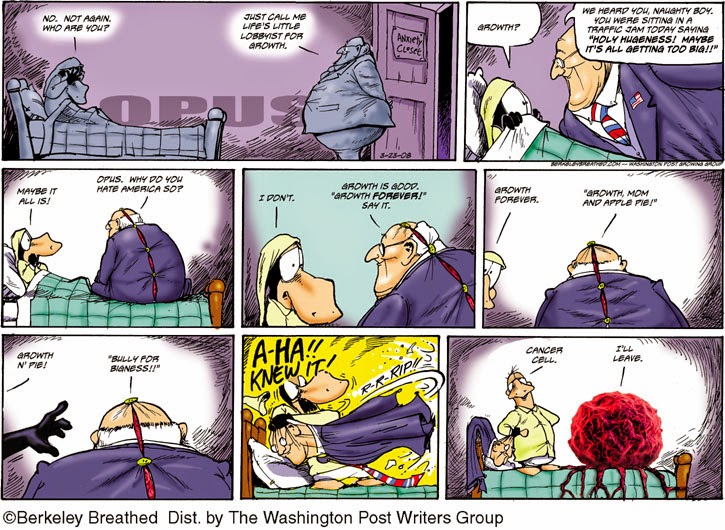
On a final note, I think cartoonist Berke Breathed of Bloom County, Outland, and Opus fame says it best here:
Tuesday, December 23, 2014
Link of the Week: Podcast featuring David Collum
In
the theme of my ‘Year of Chaos’ series of posts, this week’s link is a
Peak Prosperity podcast featuring David Collum. He’s actually a
scientist (in the
field of chemistry if I remember right) rather than a professional
economist or pundit or political wonk, but in my opinion I think that
works in his favor. He has a discerning eye for spotting patterns and
the ‘big picture’, as well as having a knack for
cutting through the BS in an entertaining way.
An excerpt below from
peakprosperity.com:
“To
me, the global economic theme is existential risk. That's a phrase I
use repeatedly throughout my Year In Review. Things now seem to be
coming to a head.
A
metaphor that I came up with, that I just love because I know the game
well, is that we're engaged in a global game of Tetris. For those
unfamiliar with
the game: you place these pieces methodically, and then the game starts
accelerating. You start placing pieces faster and faster, until you
reach some point where you simply can no longer successfully place the
pieces in time.
And
it feels like the authorities, the monetary authorities, the geo
political authorities -- all of those people who are really calling the
shots around the
globe --are playing that game, and it's accelerating now.
The end of the game is called 'topping out'. And I’m wondering when that topping out is going to occur.”
The
fact he also seems to sense a pivotal year ahead makes me feel both
encouraged (because it helps confirm I’m not totally nuts) and concerned
(because if
we’re right it means the world is going to go apesh*t). And BTW, props to him for the Tetris reference, the time-sink of choice for many people my age back in the first days of the GameBoy....
You can find the podcast at the link here or you can copy and paste the link below.
Friday, December 19, 2014
2015 as a 'Year of Chaos', Part 1: The Trends That Are the Prelude to a Wild Year
“Disorder is inherent in stability. Civilized man doesn't understand stability. He's confused it with rigidity. Our political and economic and social leaders drool about stability constantly. It's their favorite word, next to 'power.'
'Gotta stabilize the political situation in
Southeast Asia, gotta stabilize oil production and consumption, gotta
stabilize student opposition to the government' and so forth.
Stabilization to them means order, uniformity,
control. And that's a half-witted and potentially genocidal
misconception. No matter how thoroughly they control a system, disorder
invariably leaks into it. Then the managers panic, rush to
plug the leak and endeavor to tighten the controls. Therefore,
totalitarianism grows in viciousness and scope. And the blind pity is,
rigidity isn't the same as stability at all.
True stability results when presumed order and
presumed disorder are balanced. A truly stable system expects the
unexpected, is prepared to be disrupted, waits to be transformed.” ―
Tom Robbins
"Two dangers constantly threaten the world: order and disorder." - Paul Valery
As much as part of me loathes to do so, I am going
to make a general prediction for what we will likely see next year. The
quick summary of it goes something like this:
2015 will be a historical turning point that dwarfs the events of 2008-2009 or the late 1960's, and just
possibly on the same level as the events in 1914.
The two quotes above do a fair job of describing my
reasoning for this expectation. Simply put, the architects and the
‘managers’ of the economic and political systems that dominate the world
have been working so hard at maintaining the
status quo and inhibiting change that disorder is not only expected,
but the severity of the disorder will be proportional to the magnitude
of previous and current efforts made to prevent it. I don’t expect
every country in the world will experience the effects
equally, but I do expect that taken as a whole it will make the ‘Arab
Spring’ of several years ago look like a college keg party. I am not saying that I WANT this level of highly disruptive change, I am only saying that it is what I EXPECT to happen. It would be nice if changes could be introduced or occur on a more gradual basis so people and societies have more time to adjust, but the intense efforts made by the status quo to prevent any meaningful change have pretty much baked serious unrest and major disruption in to the cake. Mass civil unrest, collapsing economies, multiple regional wars, revolutions.... these are the kinds of things we can expect in the years to come, and from the warning signs I see I expect next year will be when these things begin to rear their ugly heads. Some such events may not reach their ultimate climax until some years later, but I believe that next year will be recognized as the start of this era of disruption.
A list of some of the warning signs we are seeing, in no particular order:
- The ongoing collapse in oil prices both in the US and abroad. http://www.peakprosperity.com/blog/89380/oil-and-global-slowdown
- The continuing economic weakness throughout the world. http://www.peakprosperity.com/blog/89380/oil-and-global-slowdown
- The economic crisis in Russia. http://www.zerohedge.com/news/2014-12-16/outspooking-lehman-apocalypse-could-russian-default-be-cards
- The growing instability of the Middle East, including but not limited to the gains and spread of the Islamic State in Iraq and Syria. http://www.inquisitr.com/1677755/unrest-in-the-middle-east-intensifying-ahead-of-troop-withdrawals/
- The growing tensions between Ukraine and Russia. http://www.zerohedge.com/news/2014-12-16/obama-sign-lethal-us-aid-ukraine-end-week-russian-response-follow
- The worsening economic picture as well as the size and the rate of growth of money-printing measures in Japan. http://www.zerohedge.com/news/2014-11-18/japan-dying-and-we-still-dont-get-it
- The enormous rise (and risk of default) in subprime auto loans AND student loans. http://www.zerohedge.com/news/2014-11-07/student-and-car-loans-go-exponential-courtesy-uncle-sam http://www.zerohedge.com/news/2013-11-07/student-and-car-loans-represent-99-all-consumer-credit-taken-out-past-year
- The continuing economic slowdown in China. http://www.zerohedge.com/news/2014-10-27/chinese-soft-landing-will-inevitably-lead-very-brutal-hard-landing-pettis-warns
- The increasing trend in civil unrest all around the world. http://www.cnbc.com/id/102263069
The funny thing is that these trends are hardly new and they're not exceptionally grave or
apocalyptic in scope. We've experienced these kinds of things many times before, and while they've been disruptive, most societies largely worked their way through them. In the present day, however, we are in a different situation. The true danger today lies not in these trends, but rather in that the economic,
political, and social systems in much of the world (particularly the
Western world) are now too fragile to handle any significant
stress. Much of the world has simply borrowed too much money, exposed
themselves to too much financial risk, built too much dependency in
their citizens, and depended way too much on top-down (i.e. political)
solutions to their problems. In an earlier era
where our economic, political, and social systems were more resilient,
these kinds of trends would be painful and problematic but ultimately
the systems would bounce back. Now, however, we have introduced so much
fragility and dependency in our lives and
societies that these trends pose a systemic risk, not just a period of
pain. And that fragility will shape our responses to the events to
come, and those responses, whether they are economic, social, political,
or military in nature, will be what makes the
next year exceptionally chaotic. Of course, it doesn’t help that we’re
dealing with these troubling trends all at once rather than one or two or three
at a time. The late 1960's were way before my time, but my understanding of the trends, events, and social mood at that time is that everything seemed to be happening or going crazy all at once, quite similar to my expectations for next year and the years to follow. Of course as flawed as some aspects of society were then, it was more resilient than what we have today. So the people that think we'll get by this time with some small changes and adjustments like we did then are going to be in for a rude awakening.
Already we've seen heavy-handed and extreme responses made to inhibit change and maintain the status quo, with said responses ultimately increasing the fragility in our social and economic systems and in some cases feeding the very disorder it's meant to quell. We see it in the epic levels of money-printing/money-creation going on
in the US, Japan, China, and elsewhere.... done in large part to prop up the financial status quo and in some cases to
enrich powerful banking interests. We see it in the increased aggressive nature in foreign policy and the increase in military actions and threats across the world (the US being a huge part of it but hardly the only party to blame). We see it in the militarization of the police in America and the ballooning of surveillance targeting ALL US citizens, not just the so-called 'terrorists'. And we see it in political systems and mainstream media outlets that focus public attention on issues that aim to divide us on racial, class, religious, and generational lines so we don't notice the thievery and corruption taking place at the highest levels. Expect the responses from the status quo to only escalate from here.
Tuesday, December 16, 2014
Link of the Week
As
much as I try to not be judgmental of others’ quirks, hobbies, or
fetishes, I find the whole idea of ‘Furries’ to be funny as hell. And
for those who say
“chemical attacks are no laughing matter”…. sorry but you’re wrong,
because this is bloody hilarious. The only thing that would make this
better is if the president had been forced to reference this incident in
some kind of anti-terrorism statement. What's the matter Obama? Willing to push for war with Syria over a staged chemical attack they weren't responsible for, but won't lift a finger to help some law-abiding, if freaky, citizens in your own home town? For shame....
“In a particularly vicious alleged chemical
attack, thousands of MidWest FurFest "Furries" -
the term for people who dress up in expensive animal costumes and role-play (sometimes sexually) as anthropomorphic critters - were evacuated when chlorine gas was released in the Chicago Hyatt
hotel in which they were nesting.
As AP reports, authorities are investigating the release of a gas
that sent 19 "people dressed like dogs and foxes," as a criminal matter -
as someone apparently
intentionally left chlorine powder in a ninth-floor hotel stairway, causing the gas to spread.
Does give one paws for thought though, eh?”
Read the rest of the article at the link here.
Well well... might we have a suspect?

Sunday, December 14, 2014
More on “The Basic Laws of Human Stupidity” – Part IV: The ‘Bandits’
“In
a closed society where everybody's guilty, the only crime is getting
caught. In a world of thieves, the only final sin is stupidity.” -
Hunter S. Thompson,
Fear and Loathing in Las Vegas
It’s
that time again to talk more about “The Basic Laws of Human
Stupidity”. Having already discussed the ‘Intelligent’ and the ‘Stupid’
groups at length,
let’s dig down and discuss the ‘Bandit’ group and the people that fit
in that category.
In
the context of these Laws of Human Stupidity, the definition of a
Bandit is a person who makes a gain while causing a loss to another.
Though I prefer
the description found in Wikipedia, that Bandits are people who pursue
their own self-interest even when doing so poses a net detriment to
societal welfare. Yet
as I described in previous posts, there is variability
in this group and differences in the proportion of how much gain one
receives compared to the loss they incur on others. The ‘Intelligent’
Bandits tend to receive more of a gain than the losses they incur on
others, whereas the ‘Stupid’ Bandits tend to receive
a gain significantly less than the loss or damage they incur on
others.
Intelligent Bandits
Good
examples of an Intelligent Bandit would be the merchant or salesman who
overcharges his/her customers through various schemes (advertising a
product as
something better than it really is for example), or a toy manufacturer
who makes additional profit by quietly substituting various components
in their product with substandard parts. In both cases the consumer
incurs small, subtle losses while the Bandits
tend to receive more direct financial gains for themselves. Perhaps an
even better example of an Intelligent Bandit would be some of the more
shrewd politicians out there. The kind that talks big but tends to do
relatively little in office (thus causing
less damage), yet manages to enrich themselves through trading stocks
on insider knowledge, capitalizing on social and business connections
made in office, and influencing legislation in ways that turn a profit
for them. Their ‘cost’ to others is in the form
of salary and benefits and in some cases bits of legislation that
incurs a small net loss to the country or the people, but they manage to
leverage that into gains far more substantial than said salary,
benefits, or questionable minor legislation. Heck one
can argue (I certainly will) that many voters ‘vote’ like Intelligent Bandits, voting in
politicians promising to direct tax money to whatever government program
or industry that personally benefits them, even though it has a small
negative impact to the rest of the taxpayers and the country as a whole.
It’s important to note, however, that such voting behavior shifts definitively into
the Stupid Bandit column once the effects depart from the modest
siphoning of taxpayer money, and instead introduce or promote major
instability or fragility into the system.
Some of those who still buy in to the whole left vs. right, Democrat vs. Republican paradigm may heavily disagree, but I think one of the better, more recent examples of an Intelligent Bandit politician would be Sarah Palin. She didn't really have much impact as governor one way or the other and her bid as Vice President didn't come to fruition (hence her direct 'take' from the taxpayer and society was small), but she's managed to leverage a short political career into lucrative book deals (I saw her book on sale in a bookstore in Ulaanbaatar, Mongolia of all places), commentator gigs on cable news, and speaking engagements. Say whatever you like about any more fundamentalist Christian beliefs she may have and/or panders to, but the way she's managed to enrich herself to a greater proportion than the amount she took as governor of Alaska and Mayor of Wasilla demonstrates an Intelligent Bandit leaning.
Stupid Bandits
A
Stupid Bandit might be typically described as the garden-variety thief,
such as the kind of person who smashes a $250 car window to snatch a
$150 car stereo
that he’ll sell for $35. Unfortunately it’s not the typical burglar or
thief that creates the most damage to society, even though they usually
get the most attention from police and the media. The truly dangerous
Stupid Bandits include such people as corrupt
bankers, companies, bureaucrats, and politicians. Think of the banks
who made billions facilitating unethical & risky real estate deals
and bundling them up into mortgage-backed securities to sell to
investors as AAA safe investments, eventually creating
a crisis that has cost into the TRILLIONS in damage to the economy and
direct costs to taxpayers for bailouts. Or the groups of corporations that
have essentially formed cartels (most often in
collusion with
the politicians to whom they give campaign donations) in critical
industries like health care, aerospace & defense, banking, and
energy sectors, enriching themselves at great expense to the consumer, the taxpayer, and the free market. Or the shills and stakeholders in the military-industrial complex working the political process to encourage unnecessary and
expensive military intervention around the world so billions of taxpayer
money will be directed towards military spending (and in the process also
throwing away the lives of thousands of Americans
and even greater numbers of foreign noncombatants). Or the politicians
on the more sociopathic end of the spectrum, who not only enrich
themselves through their office but also bankrupt the country and
destroy personal freedoms of ALL their constituents merely
to amass more power and wealth for themselves. And lastly, the people
who donate to and vote for the aforementioned sociopaths because of
campaign promises to keep the government money rolling in to benefit
themselves, whether they get it in the form of direct
government assistance, special tax breaks, or government favoritism to
certain companies or industries or unions. All of these people and
entities are akin to locusts…. devouring so much in their greed and unbalanced self-interest that
they destroy the very environment they depend on.
I'm hard-pressed to find the best recent example of a Stupid Bandit politician in the US, since there are so many to choose from. But given the events of the past few days, I'd say said example includes every douchebag who voted yes to approve the Cromnibus bill that will put the taxpayers potentially (though I'd say almost definitely) on the hook for over $300 TRILLION in derivatives bets held by the big financial institutions. I say to these people enjoy your 30 pieces of silver while you can, because whatever compensation you received will be absolutely dwarfed by the scale of damage done when the big financial institutions decide to take even more risks which will lead to this derivative bomb being even more destructive than if it should blow up now. It is stunts like this that lead to violent revolutions and civil unrest.

The Trend Towards Banditry
It
would be simple to think that a proportional increase of the Stupid
group would be contributing to America’s decline, but it’s my opinion
that the increase
in Bandit-like behaviors and the growing acceptance of these
behaviors is far more to blame (I also think Helpless behaviors are also
heavily contributing, but that’s a topic for a later post). And to be
honest, it’s not really a surprise to see the
Bandit group growing in number. After all, consider the examples from
big business and government that we are given:
- Unethical
corporate bankers make billions in crooked deals in the real estate
market last decade which led to an epic bust and economic crisis, yet
are fined
a small proportion of the profits they made on said dealing and NONE of
the big fish responsible went to jail (see Matt Taibi's piece in Rolling Stone for more).
- The
extremely politically well-connected former NJ Governor Jon Corzine led his company MF Global in an epic campaign of speculative trades and
misuse of segregated
customer funds, which led to the bankruptcy of the company and
customers losing millions of dollars (the last of whom finally got paid
back only this year). No jail time for him or anyone at the company,
and not even a bloody FINE for Corzine. Hopefully the civil lawsuits against him gain traction, but given how much responsibility he's been able to avoid thus far, I wouldn't bet money on the lawsuits winning.
- Certain
police & sheriff’s departments as well as the federal government
routinely engage in the form of legalized theft innocently referred to
as ‘civil forfeiture’,
where they can confiscate money and assets on the mere suspicion (no proof needed) that said money or assets are involved in a crime.
Said departments most often deliberately target people that don’t have
the resources, time, or ability to mount a legal
defense (immigrants, out-of-towners, people on the fringes of the economy, etc.). A percentage of
said confiscated funds go the police department in question, creating a perverse incentive to engage in the practice.
- Elected
officials in Congress until very recently were legally allowed to
indulge in insider trading, a practice which would land the rest of us
in jail, and
many were getting extremely wealthy from it. And while it’s
technically against the rules now, imagine the total lack of surprise
when Congress AND the ‘transparency president’ Obama quietly undid much of it, making the risks of elected officials getting
caught much lower.
- Huge
corporations give bribes… er, campaign money…. to politicians to influence the political process and regulatory agencies so they can
form de-facto
cartels, reduce competition, and cripple the free market to benefit
themselves.

Subscribe to:
Posts (Atom)